Maciej Pawłowski is a composer, conductor and director – but Cosmic Scores is not simply a catalogue of music. It is a place where sound meets the light of the stars, and a score becomes a map of an inner journey.
Since childhood, he has looked at the sky not as a tourist, but as someone searching for traces of a greater order. Astronomy is not a decoration added to the music, nor a theme placed on top of it. It is a way of thinking about time, space, solitude, light, memory and the place of the human being in the Universe.
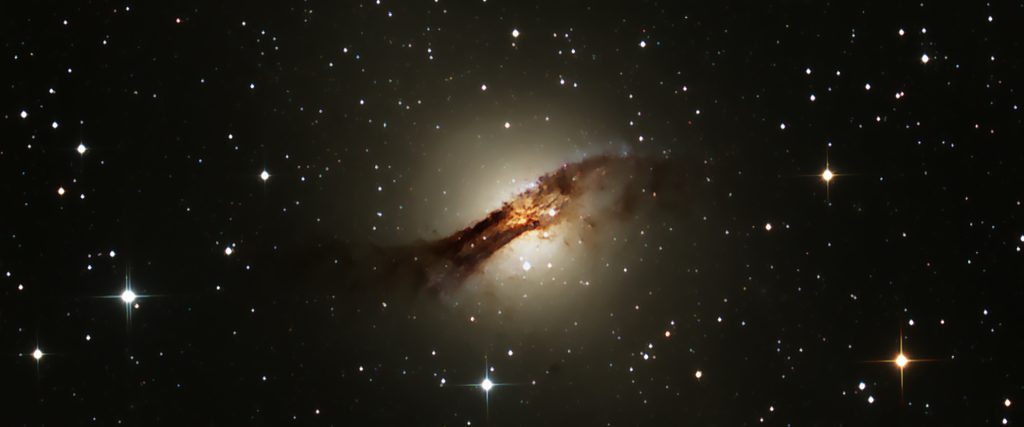
This is why he travels to places where night regains its original depth. On the plateaus of Namibia, under the skies of La Palma, in the deserts of California, Utah, Nevada and Arizona, he searches for places where the Earth becomes quiet enough for the cosmos to be heard. There, far from the lights of cities, photons that have travelled for thousands and millions of years touch the camera sensor – and time, incomprehensible to the human mind, leaves its trace on an image.
Astrophotography is not merely an image here. It is evidence of an encounter. It is the record of a moment in which the human being, technology and infinity stand before one another in silence. From these places, the first musical sketches are born – not as illustrations of photographs, but as their hidden voice. Later, they are developed in Poland, in a studio surrounded by forests and fields, where the silence of the night sky returns as sound.
Cosmic Scores / Kosmiczne Partytury is a separate chapter in the work of Maciej Pawłowski. In his musicals, ballets and jazz works, he uses melody, dramatic narration, the human voice, instruments and the living energy of the stage. In electronic music, he chooses a different path. He does not build an orchestra out of imitation. He does not try to pretend that electronic sounds are acoustic instruments. He does not transfer the language of musical theatre or jazz into this world. Instead, he creates an autonomous universe – synthetic, cosmic and inward.
This music is not meant to be a display. It is not a virtuoso demonstration of a performer’s abilities. Its purpose is not to dazzle with speed, density or spectacle. Its purpose is to lead.
In Maciej Pawłowski’s electronic music, melody often remains simple, almost ascetic. It may return like a signal from a distant probe, like the pulse of a lighthouse at the edge of darkness, like a thought that refuses to disappear. But beneath this simplicity, deeper layers are in motion. The further planes of sound are not background – they are the hidden life of the score. This is where micro-events, tensions, breaths, shadows of rhythm and subtle shifts take place, changing the listener’s sense of perspective.
The rhythm may be complex, but never for the sake of complexity alone. The form may be expansive, but not in order to impress with scale. Every layer is meant to carry the listener further – through chaos, through light, through fear, through wonder, through the loss of orientation, until sound begins to resemble space.
What distinguishes Cosmic Scores from many electronic music projects is not only its sound. The difference lies deeper. This is music written by a stage composer, an astrophotographer and a person who treats the cosmos not as a visual effect, but as a philosophical question. This is not merely about creating a “cosmic atmosphere”. It is an attempt to write into sound what the eye cannot fully grasp: infinity, the longing for light, the fragility of civilization and the human desire to go beyond its own limits.
Cosmic Scores is also a space where music meets image and movement. Sound is connected here with choreography, dance, visual projections, fulldome imagery and astrophotography. The dancer’s body becomes an extension of rhythm, light becomes a partner of music, and the image of the sky becomes a stage design greater than any theatre hall.
In this work, photography can be heard, and music can be seen. Each astrophotograph becomes a gateway into a score, and each score becomes a path back to the place where it was conceived: under a dark sky, among the stars, where the human being once again tries to understand whether he is looking into the cosmos – or into the depths of himself.
Cosmic Scores is not music about space.
It is music written as if the cosmos were trying to speak through a human being.